
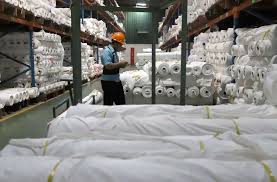
Bank Indonesia's (BI) policy of raising the benchmark interest rate (BI Rate) is considered to pose new challenges for national labor-intensive industries, particularly the textile and textile products (TPT) sector, as well as the furniture and crafts industry. Businesses believe that the era of high interest rates has the potential to hinder investment, increase production costs, and suppress domestic market demand.
At the Board of Governors Meeting held on June 9, 2026, Bank Indonesia decided to raise the BI Rate by 25 basis points to 5.5 percent. This increase follows a previous 50 basis point increase in the benchmark interest rate from 4.75 percent to 5.25 percent at the meeting held on May 19–20, 2026.
The Chairperson of the Indonesian Filament Fiber and Yarn Producers Association, Redma Gita Wirawasta, stated that the current high interest rate has the potential to hinder the development of the manufacturing industry, particularly the textile sector, which still requires significant investment to increase capacity and competitiveness.
According to him, the interest rate hike will increase financing costs, thereby reducing the incentive for industry players to expand their businesses. However, he understands that this measure was taken to maintain the stability of the rupiah exchange rate, which has been under pressure in recent times.
Redma hopes the government can prepare alternative measures to mitigate the impact of the weakening exchange rate without unduly burdening the industrial sector. He believes that several policies that have been implemented, such as the management of export proceeds (DHE), are positive steps that can be further strengthened.
Furthermore, he encouraged the government to tighten oversight of imports, especially finished products and intermediate raw materials, which have the potential to reduce the competitiveness of the domestic industry. This policy is considered to help maintain the sustainability of the national textile industry amid rising production and financing costs.
A similar view was expressed by the Indonesian Furniture and Craft Industry Association. Abdul Sobur, Chairman of HIMKI, stated that the interest rate hike would directly impact the cost of credit used by business actors to run their businesses.
According to Sobur, the furniture and craft industry is a sector that requires significant working capital, from purchasing raw materials, paying labor, the production process, product finishing, to shipping costs and awaiting payment from buyers. Rising interest rates on loans will increase these costs and restrict companies' room for maneuver.
He also believes this situation could hamper various business development plans, such as factory expansion, purchasing new machinery, developing product designs, opening export markets, and participating in trade shows. All of these activities could potentially be delayed due to increasingly expensive financing costs.
On the other hand, the impact of rising interest rates is felt not only on the production side, but also on the demand side. Sobur explained that the furniture industry is closely linked to the property sector, with projects such as the construction of houses, apartments, hotels, restaurants, offices, and various other interior projects.
When interest rates rise, property loans, consumer loans, and investment tend to slow. This condition can reduce people's purchasing power and restrain growth in the property sector, ultimately impacting demand for furniture products in the domestic market.
Industry players hope the government can implement policies that can maintain a balance between macroeconomic stability and the sustainability of the manufacturing sector. Support for labor-intensive industries is considered crucial given that this sector plays a significant role in employment and national economic growth.