
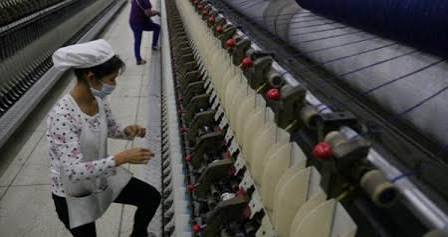
The national textile industry is facing severe pressure due to a massive influx of imported products flooding the domestic market. This situation has kept the utilization rate—the extent to which installed production capacity is being used—of textile factories in Indonesia at around 50%, hindering business sustainability and weakening the competitiveness of domestic producers.
Redma Gita Wirawasta, Chairman of the Indonesian Fiber and Filament Yarn Producers Association (APSyFI), stated that the low utilization rate in the textile industry is a direct consequence of the unchecked circulation of imported goods. This has also fostered a growing dependence on foreign products within the domestic market.
According to Redma, domestic textile producers are forced to contend with an uneven playing field against imports suspected of being sold through "dumping"—a practice where goods are priced lower than their fair market value. Consequently, local manufacturers are compelled to lower their selling prices to levels below their own production costs just to maintain their market share.
He provided an example: if the production cost is 100, dumped imports might enter the market at 80. This makes it nearly impossible for domestic producers to turn a profit, often leading to recurring losses over many years.
"If the production cost is 100 and dumped imports are priced at 80, how long can I keep selling at 80? This has gone on for years; we can’t replace our aging machinery, and eventually, we have to shut down. When factories close, the national utilization rate inevitably drops," Redma explained during the Bisnis Indonesia Forum (BIF) on Thursday (October 29, 2026).
Persistent price pressure leaves companies with no financial breathing room to modernize their machinery or expand production capacity. Over time, this situation may force factories to scale back operations or cease business entirely. Ultimately, such closures contribute to a decline in the overall utilization rate of the national textile industry. Redma also highlighted import relaxation policies, which he argues have not been balanced with adequate oversight regarding the influx of finished goods. The government has facilitated imports under the rationale of ensuring a smooth supply of raw materials for the industry. However, he believes this policy creates loopholes that allow imported goods to enter and compete directly with local products.
A particular concern for APSyFI is the relaxation of import regulations within bonded zones—areas originally intended to support export-oriented production. According to Redma, increasing leniency without strict supervision could lead to a greater influx of textile products into the domestic market, further intensifying the pressure on national producers.
"There is a constant push for import relaxation—framed by the government as 'facilitating the import of raw materials'—but this has actually become a major threat that could destroy the integration of our domestic industry," he added.
He asserts that strengthening anti-dumping policies and implementing trade safeguard measures are crucial steps to protect the domestic industry from unfair competition. Without effective protective instruments, the entire national textile supply chain—from the upstream sector, which produces fibers and yarns, to the downstream sector, which manufactures finished garments—risks further weakening.
This issue is particularly urgent because the textile industry relies on strong interdependencies across its various production stages. A decline in the upstream sector can disrupt the supply and viability of the downstream sector, while a drop in downstream production can, in turn, reduce demand for the raw materials produced by the domestic industry.
Amid these challenges, the government has begun to prioritize the textile industry as a sector requiring special attention. President Prabowo Subianto has even proposed the creation of a new state-owned enterprise (SOE) dedicated to the integrated development of the national textile industry.
The government is also addressing the various obstacles currently facing the textile and textile product (TPT) industry, including issues related to the consistent supply of raw materials. Coordinating Minister for Economic Affairs Airlangga Hartarto previously stated that the President has requested a review of technical approvals (*Pertek*) and other regulations concerning the procurement of industrial raw materials.
"The President has asked us to review the technical approvals and other related matters," Airlangga said on Tuesday (September 22, 2026).
This review is intended to help streamline the supply of raw materials, ensuring that production activities are not hindered by licensing processes or administrative requirements. Nevertheless, the smooth importation of raw materials must be distinguished from the oversight of finished goods entering the country, which could potentially put pressure on the domestic market.
In the downstream sector, the government has also highlighted the circulation of imported clothing—specifically through "by-the-kilo" and "baled" (*balpres*) import channels—which is considered detrimental to domestic garment producers. The President has instructed the Directorate General of Customs and Excise to take enforcement action regarding these import channels.